Most people who hold a non-US mutual fund or ETF have no idea it may be a passive foreign investment company in the eyes of the IRS. The PFIC Analyzer runs each holding through the two tests the IRS uses, the income test and the asset test, for every year you held it, and shows whether it is a PFIC.
Other PFIC calculators assume you already know your fund is a PFIC. The PFIC Analyzer checks first, then opens the full PFIC Calculator: the section 1291 tax and interest and a filled-in Form 8621, from the same sign-in.
Import your portfolio or paste tickers. Built and reviewed by Edward Parsons, CPA
Want the rules first? Get five short emails on the two tests that pull a fund in, what the default regime costs, and the elections that can replace it. Send me the five PFIC emails.
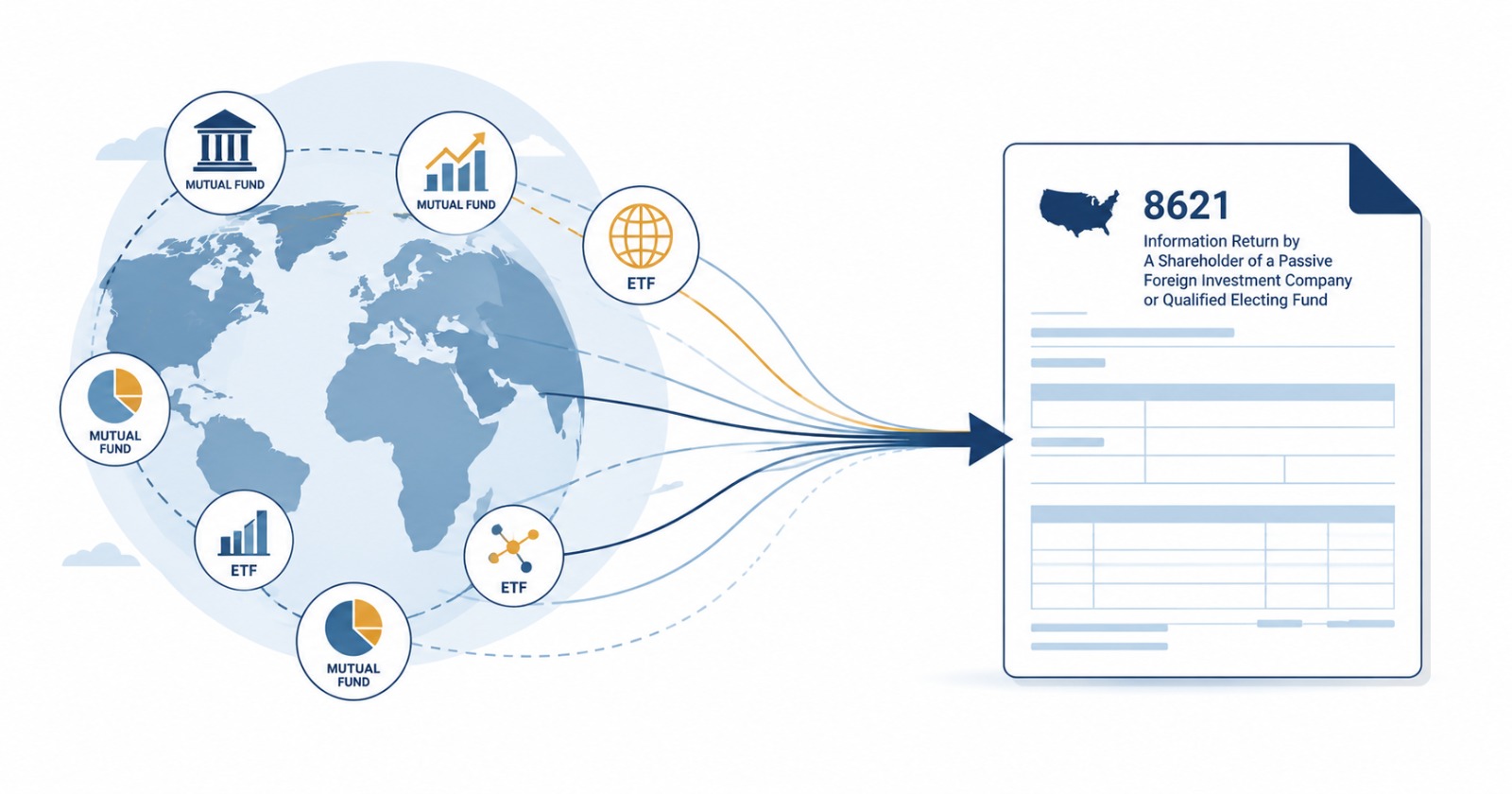
Analyze first, then calculate. The analysis is free for your first 10 ticker-years.

Paste your tickers, import the CSV template, or connect your brokerage, and choose the years you held each fund.

Each fund is tested on the 75% income test and the 50% asset test for every year, from the company's published financials, with the percentages shown. Foreign-domiciled funds are flagged as PFICs.

If a fund is a PFIC, the full PFIC Calculator is already open: excess distributions, the section 1291 tax and interest, and Form 8621 at $30 per form. Or have us prepare it for you.
A foreign corporation is a PFIC if it meets either of two tests in a given year. Meeting just one is enough.
Your fund is a PFIC if 75 percent or more of its gross income for the year is passive. Passive income includes dividends, interest, rents, royalties, and most capital gains. Because foreign mutual funds and ETFs exist to generate exactly that kind of income, they usually clear this bar.
Your fund is also a PFIC if at least 50 percent of its assets, measured on average over the year, are held to produce passive income. Cash waiting to be invested often counts. A fund can pass the income test in a slow year and still trip the asset test.
The complications live in the details: how foreign income is characterized, how assets are valued through the year, and how look-through rules apply when one entity holds another. Those nuances are where a wrong call gets expensive, and where a CPA review earns its keep.
If the analyzer flags your investment as a PFIC, you may be required to file Form 8621 for that fund, for every year you held it. If it comes back as not a PFIC, it is still worth a second look before you rely on that, since a single year's numbers can change the answer. The analyzer gives you a strong, fast indication. It is not a substitute for a filing determination on your actual return.
Owning a PFIC is not a problem you can ignore, but it is one you can fix. Form 8621 is filed per fund, per year, and two elections, the qualified electing fund election and the mark to market election, can soften the tax treatment. Both are time sensitive, so the window matters. The calculator covers the default section 1291 regime; if an election may apply, or prior years were never reported, request a quote and we will review your holdings with you.
You pay per ticker-year: one fund for one tax year. One fund analyzed over 4 years is 4 ticker-years.

One time, for every new account. Enough to analyze two funds over five years.
After the free tier. Example: 3 funds over 5 years is 15 ticker-years, so 10 are free and you pay $50.
One form per fund, per tax year. Paid once: reprints and prints after a recalculation are free.
A CPA checks your workpapers before you file. The same 3 funds over 5 years: $400 + $750 = $1,150.
Rather hand it all over? See the price for us to prepare your Forms 8621, or request a quote for unfiled years or elections.
Under the default rules, PFIC gains are taxed at the highest ordinary income rate for every year you owned the fund, plus an interest charge that runs back to the first year. The favorable long-term capital gains rate does not apply. That is why catching PFIC status early, before the default regime locks in and elections expire, can change the outcome by a wide margin.

Want the rules first, before you run your numbers? Send me the five PFIC emails. There is a confirmation email first, and you can unsubscribe from any of them.
Analyze and calculate yourself, add the optional CPA review, or have us prepare your Forms 8621 for you. Unfiled years, several brokers, or a QEF or mark-to-market election? Request a quote and we will scope it.

“Ed is professional and knowledgeable. He is always available for any questions I might have. There is no one better for my expat taxes.”
“Edward helped me with international tax matters with the IRS. He was clear, patient, and effective; he resolved in weeks what had been worrying me for months.”
“Ed has helped me with my international tax needs for several years. I highly recommend him.”